Who’s Entitled to Life, Liberty and the Pursuit of Happiness?
A few years ago, on a trip to Ireland, I learned more about my great grandmother, Mary Gardiner, who lived in County Clare, in a rural area between the towns of Ennistymon and Lisdoonvarna, which is now famous for its music festival.
I visited the house where she grew up, now abandoned and in a poor state. It was, however, in an area that is now relatively prosperous, where many farms and acreages have breath-taking views of the nearby Atlantic coast.
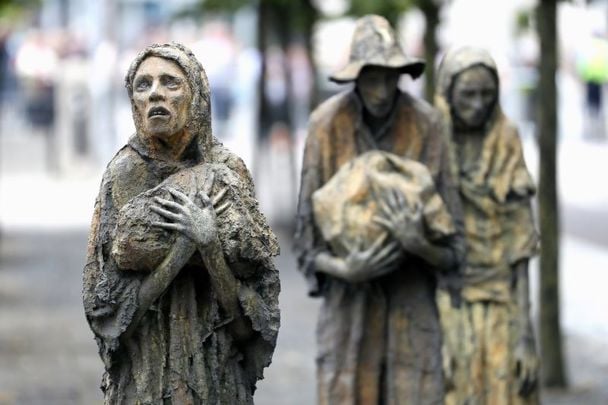
In her time, things were not so good. So, in 1945, at the age of 16, she emigrated to the U.S. That was the year the Great Famine began. In case you’re not up on your Irish history, the famine was a devastating period of mass starvation, disease, and emigration in most of Ireland, due mostly to successive failures of the potato crop. It lasted until about 1852. It is one of the defining events in Irish history and had a profound impact on Irish society and culture.
Among Ireland’s Poor Counties
Even before the famine, Clare was among Ireland’s poorer counties, according to ChatGPT. Many families rented tiny plots, paid high rents, had almost no savings and depended almost entirely on one successful potato harvest. The potato crop was absolutely essential. A healthy family could survive on potatoes and buttermilk for much of the year.
I had a sampling those conditions on my first trip to Ireland in 1960 where I met distant cousins. The family of Owen McNulty lived on a 40-acre farm, most of which was rock. They owned two cows, which they had to graze in a ditch along a nearby road. You had to drive through a neighbor’s property to get to their house, which had an uneven linoleum floor, single open fireplace and thatch roof. The homes I’ve visited in rural Latin America so remind me of that house.
We don’t know exactly what kind of desperate conditions made 16-year-old Mary Gardiner leave her family and friends to make the onerous boat trip across the Atlantic. But according to an obituary in the Emmetsburg, IA newspaper – an Irish American town named after Irish patriot Robert Emmet where she spent most of her adult life – she eventually married Robert Carney in 1857 and had five children, one of which was my grandfather, James Carney. Mary Gardiner died in Emmetsburg at age 93.
Most Were Welcomed
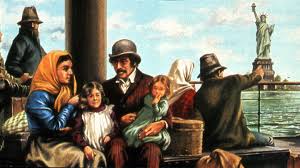
Mary Gardiner’s story is hardly unique. Thousands of Irish and millions of immigrants from all over Europe and many other continents emigrated from their homelands to America in that era. Many were greeted and welcomed by the Statue of Liberty in New York’s harbor. Despite some opposition, most, I believe, were also welcomed by Americans and they and their offspring contributed immensely to the U.S. economy and culture.
Are we welcoming today to those who come here for reasons similar to what prompted Mary Gardiner to emigrate? I wish. Earlier this month, Pope Leo – the first American pope – wrote a letter to his country on its 250th anniversary that touched on the subject.
He referred to the famous U.S. Declaration of Independence, which says it is self-evident that “all men are created equal, that they are endowed by their Creator with certain unalienable rights, that among these are life, liberty and the pursuit of happiness.”
Created in the Divine Image
“While couched in the language of the Enlightenment,” Pope Leo wrote, “that claim is ultimately grounded in an understanding of the human person inspired by the great biblical vision of man and woman being created in the divine image. It is indeed here that we discover the basis of human dignity; dignity which precedes the establishment of any state, and whose custody constitutes its very purpose.
“Defending human life … includes welcoming, protecting and assisting immigrants, whose hopes, sacrifices and contribution have formed part of the history of this country from its very beginning. In every generation, those who have arrived seeking freedom, opportunity and a place to belong have helped to shape the nation’s character.
“To receive them with compassion and generosity is not only an act of charity, but also a recognition of the dignity that belongs to every human person.”